On a hill overlooking Kathmandu, a white stupa has watched over the city for centuries. Visitors come to Swayambhunath for its temples, its monkeys and the Buddha’s immense eyes, but gaining a little height is enough to discover a place that tells a much deeper story: the ancient history of the valley and the way different spiritual traditions have lived side by side here.
Above Kathmandu
It is worth stepping away from the bustle of the streets for a moment and gaining some height. As we make our way up toward Swayambhunath, Kathmandu gradually seems to fall away. The sounds grow more distant, the rooftops spread out below, and the first silhouettes of temples appear behind the trees.
For those who approach via the grand eastern staircase, the ascent is part of the experience. Hundreds of steps lead up the hillside to the site. Vendors line the path, pilgrims climb at their own pace, and monkeys move around with an ease that quickly reminds us why Swayambhunath is often called the Monkey Temple.
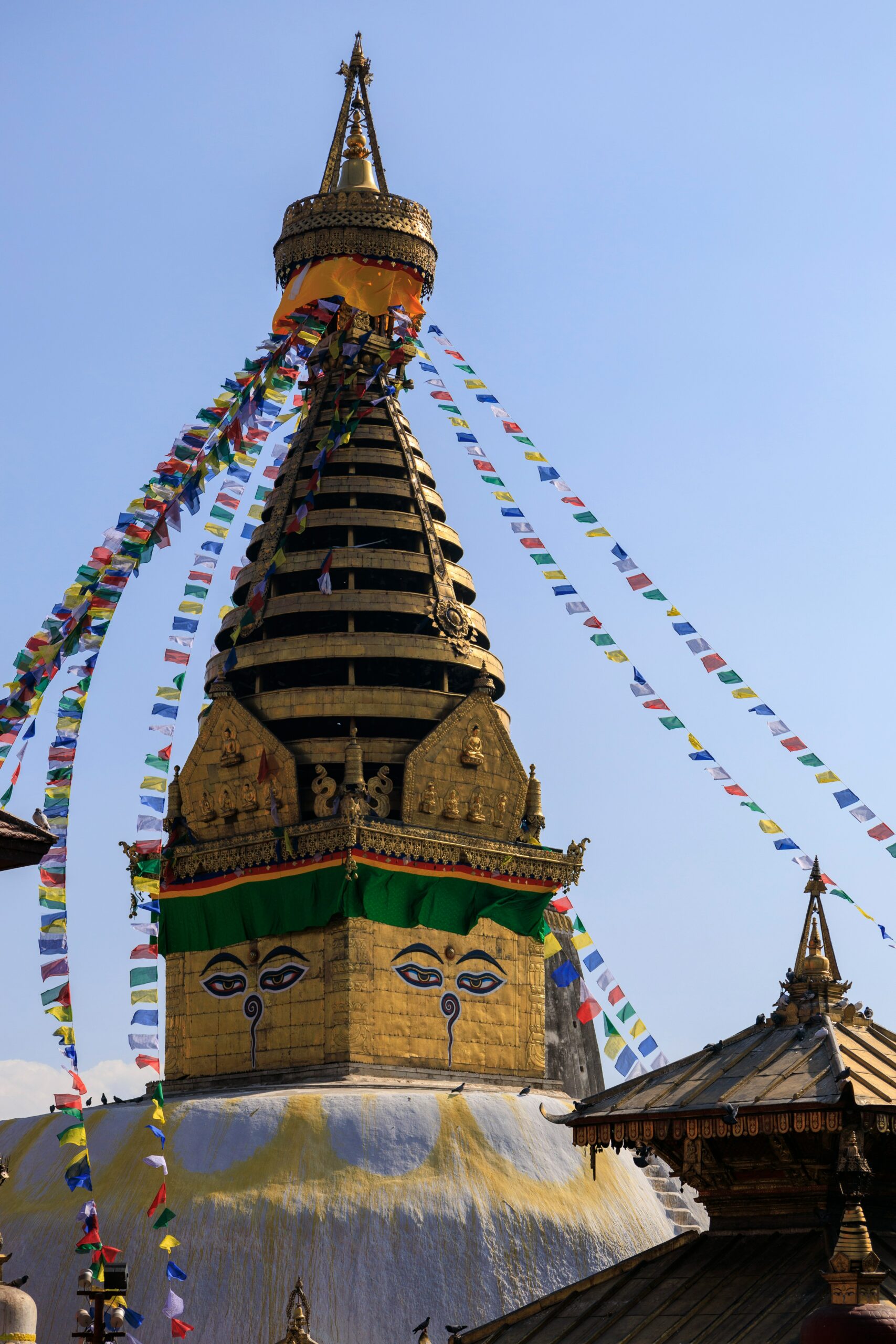
At the top, the great white stupa stands at the center of the courtyard. Its dome is crowned by a golden structure bearing the Buddha’s eyes, turned toward the four cardinal directions. Prayer flags stretch across the sky, prayer wheels turn beneath the hands of pilgrims, and a multitude of small temples, statues and shrines fill the space around the monument.
Beyond this ensemble, Kathmandu comes into view. The city spreads out below the hill, vast and densely built, stretching toward the horizon. After spending several days walking its streets, seeing it from this vantage point briefly changes our perspective: what may have seemed chaotic from ground level becomes a landscape we can almost take in at a single glance.
A Place Where History Blends with Legend
Swayambhunath is considered one of the oldest Buddhist sites in the Kathmandu Valley. Its exact origins have become intertwined over the centuries with traditions and legends. One of the best-known tells of an immense lake that once covered the region. A lotus is said to have appeared on its surface, bearing a light that arose on its own. When the waters receded, the hill of Swayambhunath became associated with this sacred manifestation.
The name itself preserves this idea: Swayambhu can be understood as “self-arisen.” Long before Kathmandu became the densely populated capital we see from the hill today, this place already held a special position in Nepal’s religious imagination.
This historical depth can be felt in the layout of the site. Swayambhunath is not simply an isolated monument to admire. The great stupa is surrounded by monasteries, statues, shrines and small structures accumulated over time. Different eras overlap, as do different practices, giving the impression of a place shaped by centuries of devotion rather than a setting frozen in the past.
Buddhism and Hinduism, Side by Side
Perhaps one of the most interesting features of Swayambhunath is precisely this coexistence. The site is often presented as a major center of Buddhism, which it undoubtedly is, yet Hindu elements are also present, and worshippers from both traditions visit the complex.
For a European observer accustomed to clearly distinguishing religions, their places of worship and their practices, this proximity can come as a surprise. In Nepal, the boundaries are sometimes less clearly defined. Buddhism and Hinduism have shared centuries of history, particularly in the Kathmandu Valley, where certain practices, figures and sacred spaces have encountered one another over time.
Here, this coexistence does not need to be fully understood at first to be noticed. Some pilgrims walk clockwise around the stupa, while others stop at a shrine, leave an offering or light a lamp. Prayer wheels turn, bells ring, and everyone seems to follow their own gestures of devotion within the same shared space.
This is also what sets Swayambhunath apart from the sometimes simplified image of a “Buddhist temple.” The site tells a story of spirituality deeply connected to Nepal’s history, where different traditions have coexisted for centuries without losing their distinct identities.
Eyes Turned Toward the City
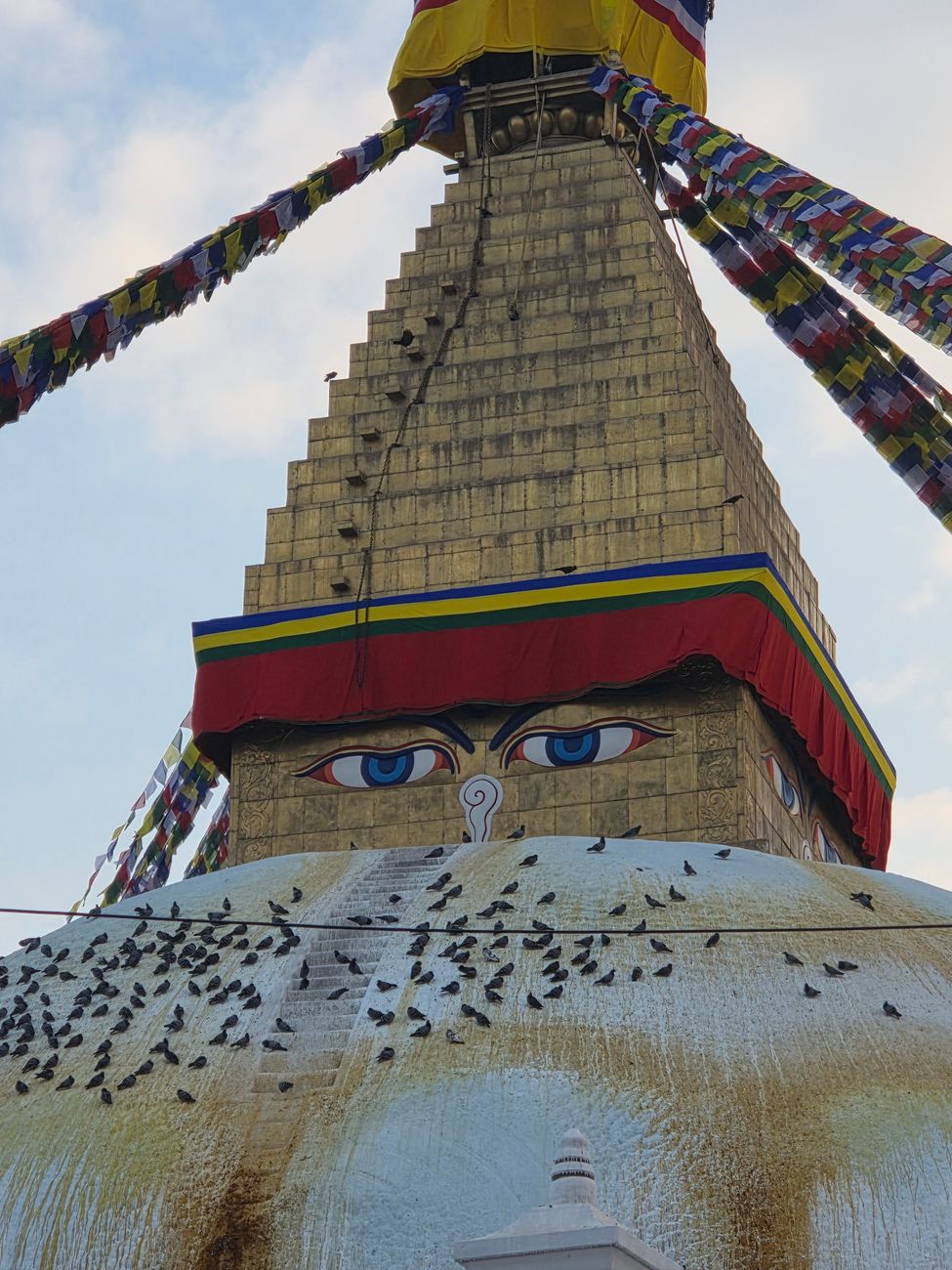
We had already seen them at Bodnath. Here, too, the great eyes painted on the four sides of the tower overlook the stupa and seem to follow visitors as they move around the monument. They are traditionally associated with the Buddha’s wisdom and awakened awareness, symbolically reaching in every direction.
At Swayambhunath, however, their presence takes on a particular dimension, perhaps simply because the site overlooks Kathmandu. As the city comes back into view below, these eyes seem almost to belong to the landscape itself. They look out over a capital that has grown and transformed while the sacred site has endured through the centuries.
The prayer flags bring their own movement to the scene. Suspended between the buildings, they traditionally carry mantras and prayers printed on fabric that the wind keeps in constant motion. Along with the footsteps of pilgrims, the sound of bells and the prayer wheels set turning as people pass, they contribute to the feeling that nothing at the summit is ever quite still.
And Then, There Are the Monkeys
They are on the stairs, the walls, the rooftops and sometimes right in the middle of the path. Some keep their distance, while others seem entirely accustomed to human presence, becoming an almost inseparable part of Swayambhunath’s familiar image.
The nickname “Monkey Temple” might make the site sound like a simple tourist attraction, yet the monkeys are part of the unusual coexistence that characterizes this place. As pilgrims continue their prayers, visitors stop to admire the views, shopkeepers welcome their customers and prayer flags flutter in the wind, the monkeys move through it all as though they have always belonged there.
This scene captures something often encountered in Nepal: the sacred does not necessarily stand apart from everyday life. It exists within it, amid its movements and sometimes even its disorder.

Seeing Kathmandu Differently
Swayambhunath is one of those places we discover as much for what it contains as for what it allows us to observe beyond its walls. From the hill, Kathmandu looks different from the city we walked through just a few hours earlier.
Somewhere below us lie the streets we explored in the preceding days, the markets, the honking horns, the crowds and the temples discovered along the way. Everything seems momentarily more distant and, perhaps for the first time, the capital can be observed as a whole rather than experienced from within its streets.
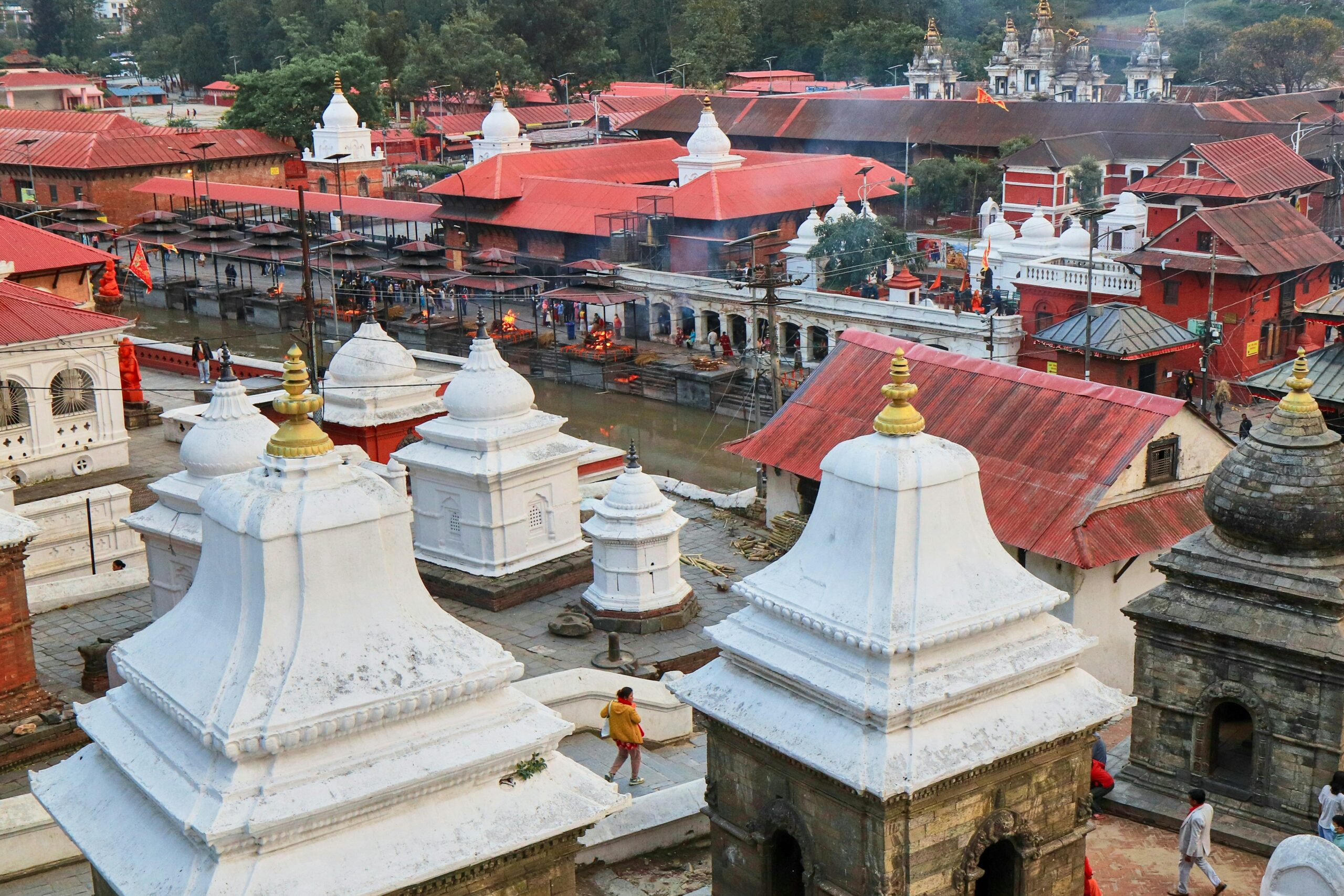
This elevated perspective also casts a different light on the journey’s earlier discoveries. After Pashupatinath and its Hindu rites, followed by Bodnath and the continuous movement of its Buddhist pilgrims, Swayambhunath reveals in its own way how these different traditions contribute together to Nepal’s spiritual identity.
Within the ORION journey, this visit marks a transition. Swayambhunath is explored at the beginning of the third day, before leaving Kathmandu for Pharping and gradually entering a more monastic environment.
Before continuing onward, there is still time to look back at the capital from the hill one last time. Between the prayer flags, the temples accumulated over centuries and the Buddha’s eyes turned toward the horizon, Kathmandu seems to reveal another facet of its history from Swayambhunath.