At Bodnath, few people stand still for long. Around the immense white stupa, pilgrims make their way forward, prayer wheels turn, and colorful flags flutter above the crowd. Sometimes, just a few minutes are enough to understand that we have not come simply to see a monument. Here, movement is part of the place itself.
A Stupa at the Heart of Life
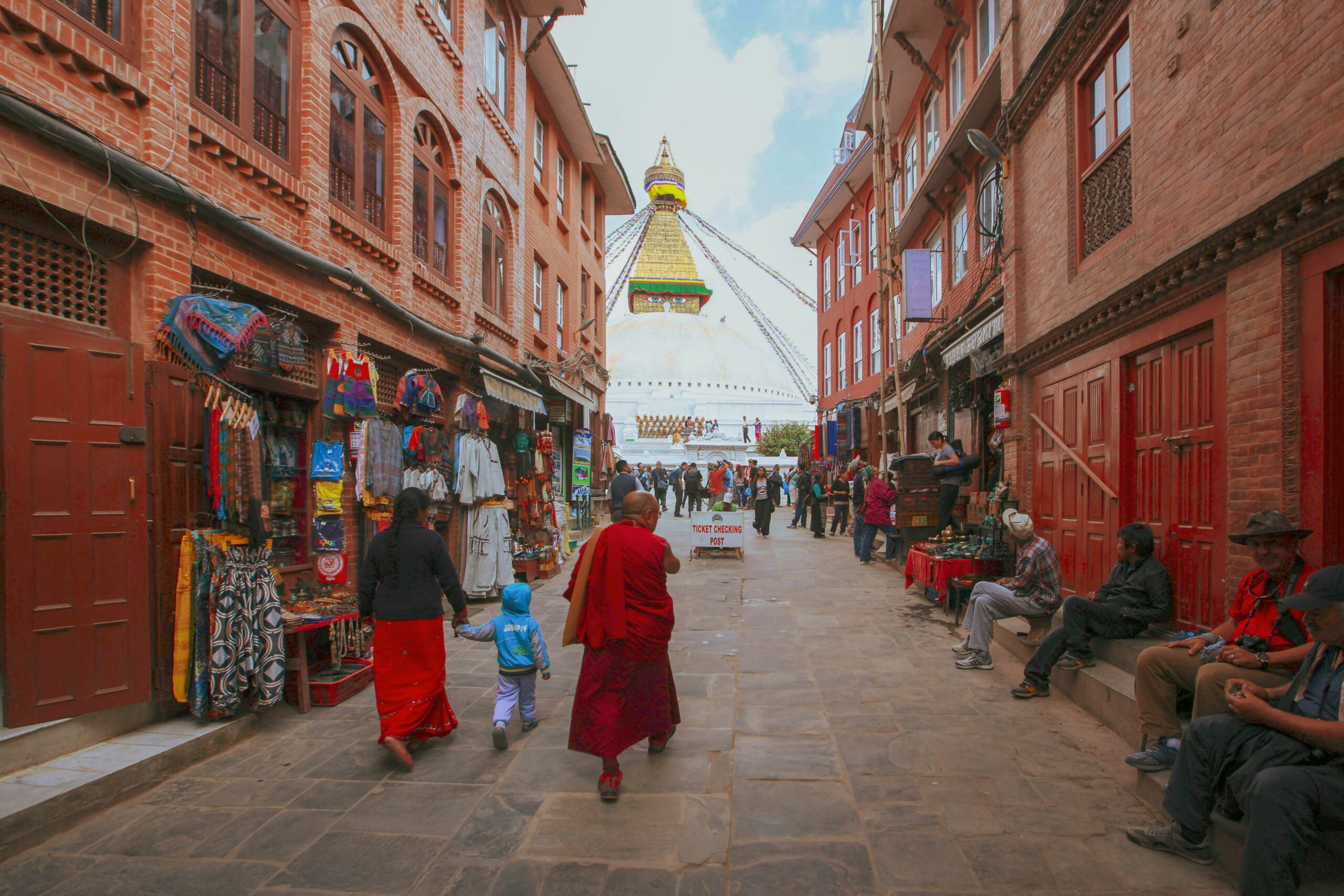
We notice it before we can even take in its dimensions. An immense white dome rises among the buildings, crowned by a golden tower painted with the eyes of the Buddha. All around it, monasteries, shops, and terraces form an almost circular square. At its center, the stupa seems motionless. Around it, everything moves.
Bodnath — also known as Boudhanath or Bauddhanath — is home to the largest stupa in Nepal. Listed as a UNESCO World Heritage Site alongside the other major monuments of the Kathmandu Valley, it has been an important place of Buddhist devotion for centuries. Yet its significance goes far beyond its size.
What strikes us most upon arriving is the way life unfolds around it. Monks in burgundy robes cross paths with families, elderly people walk slowly while passing the beads of their malas between their fingers, and pilgrims stop before the prayer wheels. Farther away, someone lights a butter lamp while others continue walking. There is no real beginning or end, only this continuous movement around the stupa.
Walking in the Same Direction
At Bodnath, almost everyone moves in the same direction. In Buddhist tradition, pilgrims circle the stupa in a ritual known as kora in Tibetan Buddhism.
Some complete a single circuit, while others make several, sometimes with a mala between their fingers or a mantra on their lips. As people come and go, each person joins a movement larger than themselves. This is undoubtedly one of Bodnath’s defining features: an individual practice becomes, across the square, an immense collective movement. Everyone walks clockwise, keeping the monument to their right.
The gesture may seem simple when we do not know its meaning. Yet for practitioners, this walk is an act of devotion in its own right. Some complete just one circuit, while others begin again and again.
Along the way, rows of copper prayer wheels accompany their steps. They bear, among other inscriptions, the mantra Om Mani Padme Hum, one of the most important in Tibetan Buddhism. Hands set the wheels turning one after another, always in the same direction as the walk.
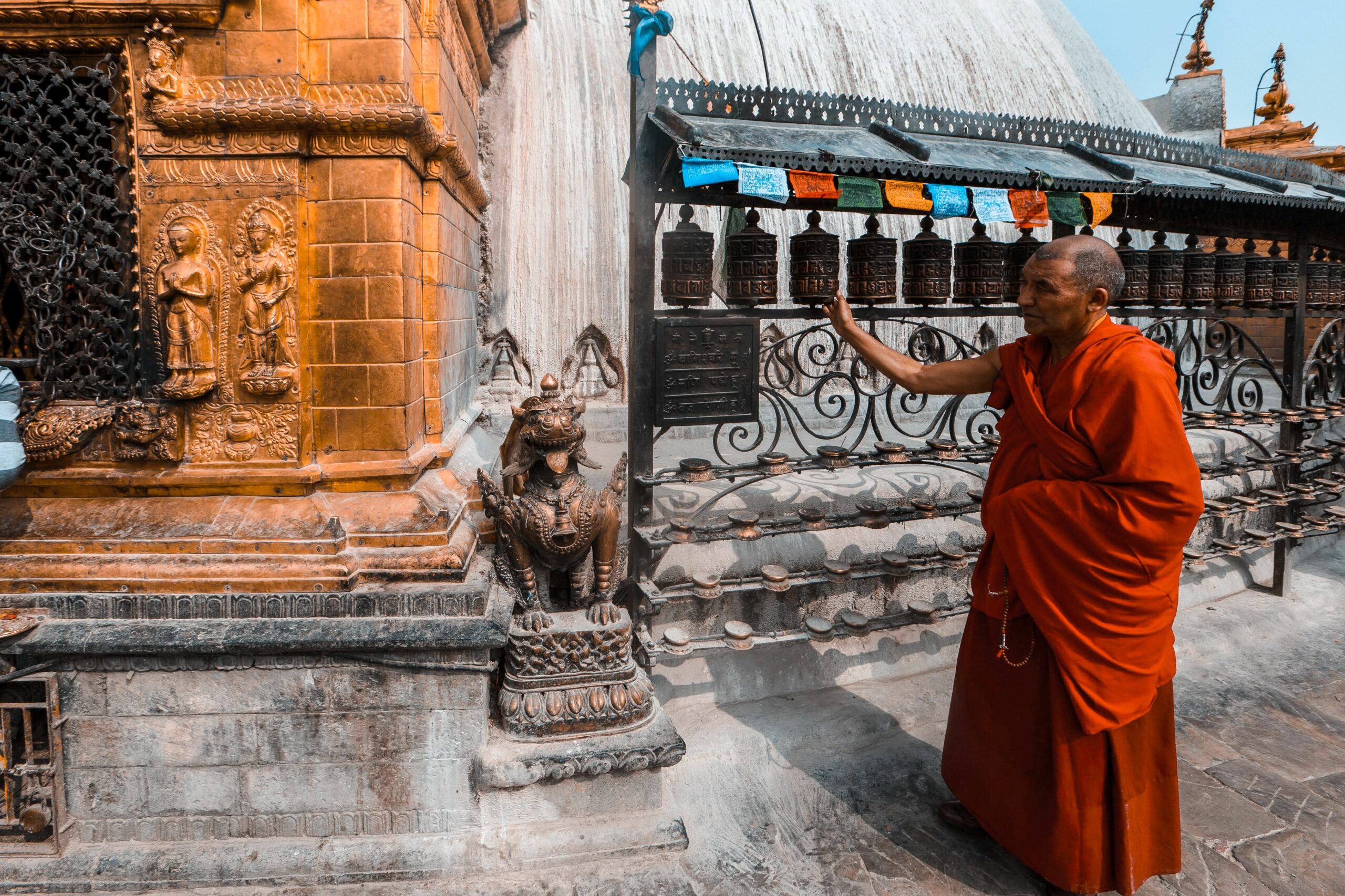
Little by little, something changes in the way we observe the place. We stop looking only at the stupa and begin noticing the gestures: a hand brushing against a prayer wheel, someone bowing, a pilgrim prostrating fully on the ground before rising and beginning again, different generations moving side by side.
What may have seemed repetitive from the outside takes on another dimension. Repetition lies at the very heart of Bodnath’s rhythm. And this rhythm belongs not only to the pilgrims. It can be heard and seen in the sounds, gestures, and movements that echo around the square: a bell rings, a prayer wheel turns beneath a passerby’s hand, a prayer is recited softly while another group continues walking. Bodnath gives the impression of a place that follows its own pace, regardless of the gaze of those who have simply come to discover it.
Eyes Looking in Every Direction
It is impossible to discover Bodnath without looking up. Above the white dome, four pairs of eyes are painted on the different faces of the square tower. Wherever we stand around the stupa, their gaze always seems to be present.
These eyes have become one of Nepal’s most recognizable symbols. They are traditionally associated with the Buddha’s wisdom and compassion, his gaze extending in every direction. Between them is a symbol that, at first glance, might be mistaken for a nose. In fact, it takes the form of the number one in Nepali script.
Higher still, the golden spire rises above the monument. Its thirteen levels symbolize the stages of the bodhisattva path. Yet we do not need to know the meaning of every symbol to feel the distinctive presence of the stupa: understanding them simply allows us to see it differently. What seemed like decoration just a few minutes earlier gradually becomes a language.
A Sacred Place in Everyday Life
Bodnath has a particular quality: the sacred never seems entirely separate from everyday life. Around the stupa, people pray, but they also talk. They enter a monastery, then settle onto a terrace. Pilgrims mingle with neighborhood residents and travelers who have come to discover the place.
This coexistence has deep roots. Bodnath once stood along a historic trade route connecting the Kathmandu Valley to Tibet. For centuries, Tibetan merchants stopped here and prayed before continuing their journeys. Even today, the neighborhood surrounding the stupa remains deeply connected to Tibetan Buddhist culture.
Perhaps this is why Bodnath is best experienced without trying to understand everything at once. Taking a few steps, observing, letting a group of pilgrims pass, listening to the sound of the prayer wheels, or looking up at the flags stretching across the sky are all part of the experience.
Because understanding Bodnath is not simply a matter of knowing its history or its symbols. It also means allowing ourselves, for a few moments, to enter its rhythm and circle with it.