Sometimes, all it takes is a single sound. A mallet gently touches metal, a note emerges, and a distinctive resonance begins to fill the space. The vibration lingers, subtly changing in texture, seeming to continue long after the movement that brought it to life.
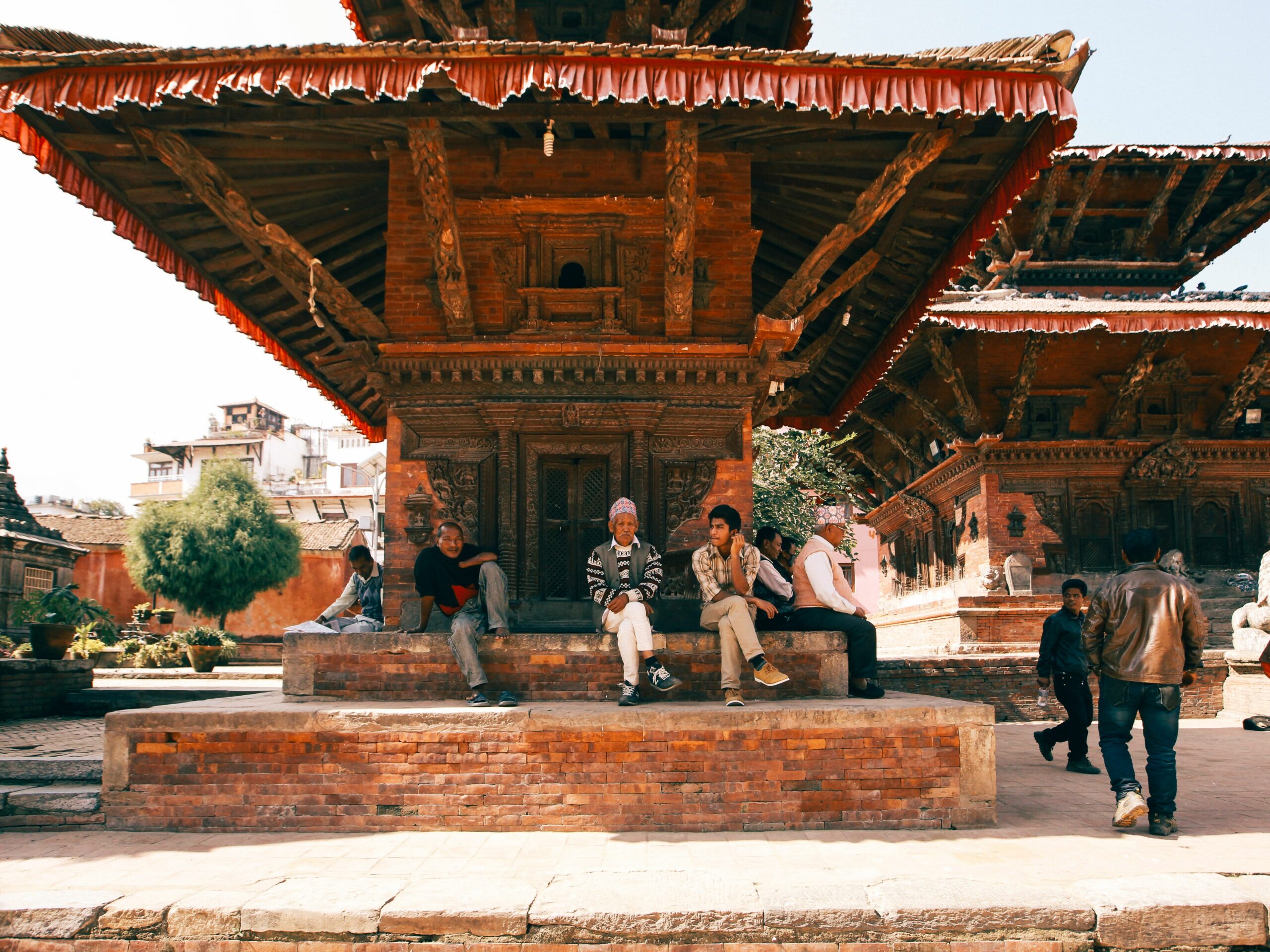
In Nepal, singing bowls are everywhere: in the shops of Kathmandu, in the hands of practitioners, and in spaces dedicated to yoga and meditation. Yet behind this familiar object lies a history far more complex than one might imagine, shaped by craftsmanship, acoustics, and a rich world of symbolism.
An Object Between Craftsmanship and Spirituality
Commonly known as “Tibetan singing bowls,” sometimes “Himalayan singing bowls,” or simply “singing bowls,” their distinctive shape, deep tones, and presence in numerous meditative practices have gradually linked them, in the collective imagination, to the spiritual traditions of the Himalayas.
Their history, however, is difficult to capture in a single narrative. It spans Himalayan traditions in which metalwork, ritual objects, and spiritual practices have long held an important place. Their contemporary uses have emerged from an evolving encounter between the metalworking traditions of Himalayan Asia and sound-based meditative practices that became particularly popular during the twentieth century.
This more nuanced history does nothing to diminish their contemporary spiritual significance. In Nepal, metalworking belongs to an ancient craft tradition, particularly prominent in the Kathmandu Valley, where statues, ritual objects, and pieces intended for Buddhist and Hindu practices have been made for generations.
Today, singing bowls belong to this world while having developed a place of their own. They accompany meditation, sometimes mark the beginning or end of a session, invite us back into the present moment, and are now at the heart of experiences built entirely around sound. Perhaps their appeal lies precisely in this meeting between something tangible and something deeply internal.
When Metal Finds Its Voice
Before it resonates in the hands of a practitioner, a singing bowl begins as material shaped by an artisan. In some Nepalese workshops, the process starts with a metal disc heated until it becomes malleable enough to work. It is hammered, returned to the fire, and struck again, in a repeated process through which the initially flat sheet gradually takes on its curved form.
The work then continues along the rim, the thickness, and the finishing details. As the shape emerges, the artisan also pays attention to the sound it produces, since the physical characteristics of each piece directly influence how it resonates.
This is where traditional craftsmanship becomes particularly fascinating. Hammer blows never produce two perfectly identical objects. Subtle variations in diameter, thickness, curvature, or regularity are enough to give each bowl its own acoustic character. Two pieces of comparable size may reveal different notes, harmonics, and resonance times.
The visible marks on the metal therefore tell us far more than how the bowl was made. They carry the gestures that gradually shaped it and contribute to its individuality. When trying several bowls in Nepal, these differences become immediately apparent: some produce a clear, luminous sound, while others seem deeper, lower, or more enveloping. Choosing one becomes a much more personal decision than simply considering its size or appearance.
Singing bowls are also often accompanied by a small circular cushion, sometimes richly colored or embroidered. Far from being merely decorative, this support keeps the bowl stable while preventing a hard surface from interfering with its vibration. The full moon singing bowl I brought back from Bhaktapur, Nepal, rests on an embroidered orange cushion, a color associated with the sacral chakra in certain contemporary practices. Other colors may be chosen in reference to the chakras: red for the root chakra, yellow for the solar plexus, green for the heart, blue for the throat, indigo for the third eye, and violet for the crown chakra. These associations do not form a universal traditional code for singing bowls, but they now play a role in how some practitioners put together their sets. The embroidery and patterns may also draw on symbols from Buddhist iconography.
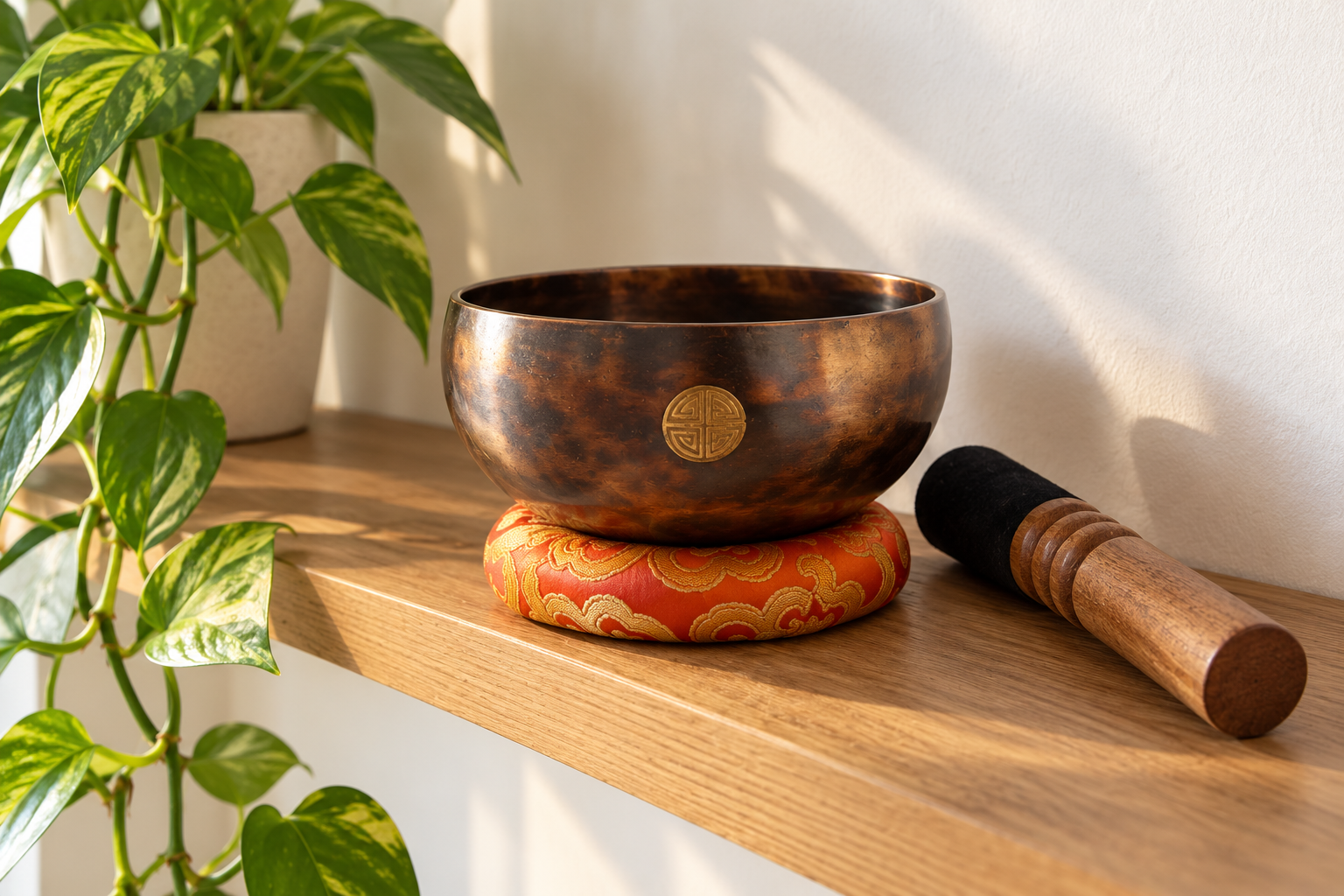
Another narrative surrounds their composition: the famous “seven metals,” traditionally associated with the seven celestial bodies of ancient cosmology. Accounts differ as to which metals are involved, and not all handcrafted bowls necessarily follow this composition. Nevertheless, this symbolism remains part of the world surrounding these instruments today and contributes to their spiritual character.
Full Moon Singing Bowls: Between Craft and Ritual
Among the pieces found in Nepal, some carry a particularly evocative name: “Full Moon Singing Bowls.”
What makes them distinctive is not simply their appearance or sound, but the ritual associated with their creation. According to artisans and the contemporary traditions surrounding these pieces, certain stages of production take place during the full moon, sometimes outdoors and under its light. The timing is chosen for its symbolic significance, as the full moon has long been associated in various Asian traditions with cycles, contemplation, and important moments in spiritual life.
In Buddhism, lunar phases help determine observance days, and several major celebrations follow the lunar calendar. In Nepal, this relationship between spirituality and the cycles of the moon gives bowls made in this context a particular meaning: the artisan is not simply working with a material, but also placing the act of creation within a chosen moment.
Some makers attribute specific energetic qualities to these pieces or consider them to symbolically carry the energy of the full moon. This belief belongs to the realm of tradition rather than scientifically demonstrated physical properties, but it remains central to the way these objects are conceived, passed down, and chosen.
How Does a Singing Bowl “Sing”?
Behind this symbolic dimension lies a very real acoustic phenomenon. When a mallet strikes the rim of a bowl, the energy of the movement sets its metal walls vibrating. These vibrations, in turn, transfer their movement to the surrounding air, producing the note we hear.
Another technique involves moving the mallet steadily around the rim. The contact sustains the metal’s vibrations, gradually bringing out the characteristic continuous sound that gives the instrument its name.
What the ear perceives, however, is richer than a single note. Several modes of vibration can coexist, producing different overlapping harmonics. The small irregularities of a handcrafted piece also contribute to its acoustic signature, sometimes creating subtle pulsations that make the sound seem to ripple through the space.
This richness partly explains why listening can become so absorbing. Certain frequencies fade quickly while others linger, allowing the resonance to evolve as it unfolds. The ear naturally follows these changes until the final harmonics become almost imperceptible.
When Listening Becomes a Practice
Making a singing bowl resonate may seem like a very simple gesture, but the experience changes when we truly take the time to listen. A note appears, fills the space, and gradually fades, creating a point of focus around which everything else seems momentarily to recede.
This is one reason these instruments have found their place in meditation, yoga, and various sound-based practices. They may mark the beginning of a session, accompany a moment of concentration, or be played together during a sound bath, sometimes alongside gongs, bells, and other instruments.
In sound healing, the practitioner creates less of a melody than a soundscape. Notes emerge from different places, meet, linger, or give way to moments of silence. When several bowls are played, their harmonics can blend, creating the impression that sound is moving around us.

Listening also becomes a physical experience when the instruments resonate nearby. Deep, sustained sounds may be felt through the body as much as heard, while more subtle variations gradually capture the mind’s attention. Some people describe a profound sense of relaxation, while others experience a feeling of grounding, calm, or a heightened awareness of their breathing.
A singing bowl also offers a tangible point of focus for entering meditation. Rather than trying to make thoughts disappear, attention can return to a particular note, follow its evolution, and notice the moment it dissolves into silence. In some contemporary spiritual approaches, different tones are also associated with chakras or the body’s energy centers. These associations vary between schools and practitioners, but they can lend a particular intention to a session.
Whether one fully embraces this energetic interpretation or is simply drawn to the instrument’s acoustic beauty, the experience remains deeply personal. All that is needed is to let the vibrations unfold and observe what they awaken.
Listening Differently in Nepal
At Vishuddhi Alaya, sound healing naturally finds its place alongside yoga, breathwork, meditation, and the moments of rest that shape the retreat. After several days spent traveling through the country and discovering its traditions, this immersion in sound opens up a different kind of space, where attention turns more fully toward sensation.
The experience also takes on another depth when we understand what we are listening to. Behind the sounds are the heated metal, the artisan’s repeated gestures, the marks left by the hammer, the subtle characteristics that give each piece its identity, and the symbols associated with certain methods of production.
An object we might otherwise have simply noticed in a Kathmandu shop reveals several dimensions at once. It belongs to a tradition of craftsmanship, possesses its own acoustic qualities, and now forms part of practices in which sound becomes a means of presence, meditation, and inner exploration.
Perhaps this is where the fascination of singing bowls truly lies. In their ability to bring together matter and the intangible, the gestures of the artisan and those of the practitioner, a vibration we can hear and a sensation each of us experiences in our own way.
As the final harmonics fade, the metal grows still, and silence gradually returns to the room. Yet this silence no longer feels quite the same: after listening so closely to every variation, we almost continue listening to what no longer resonates.