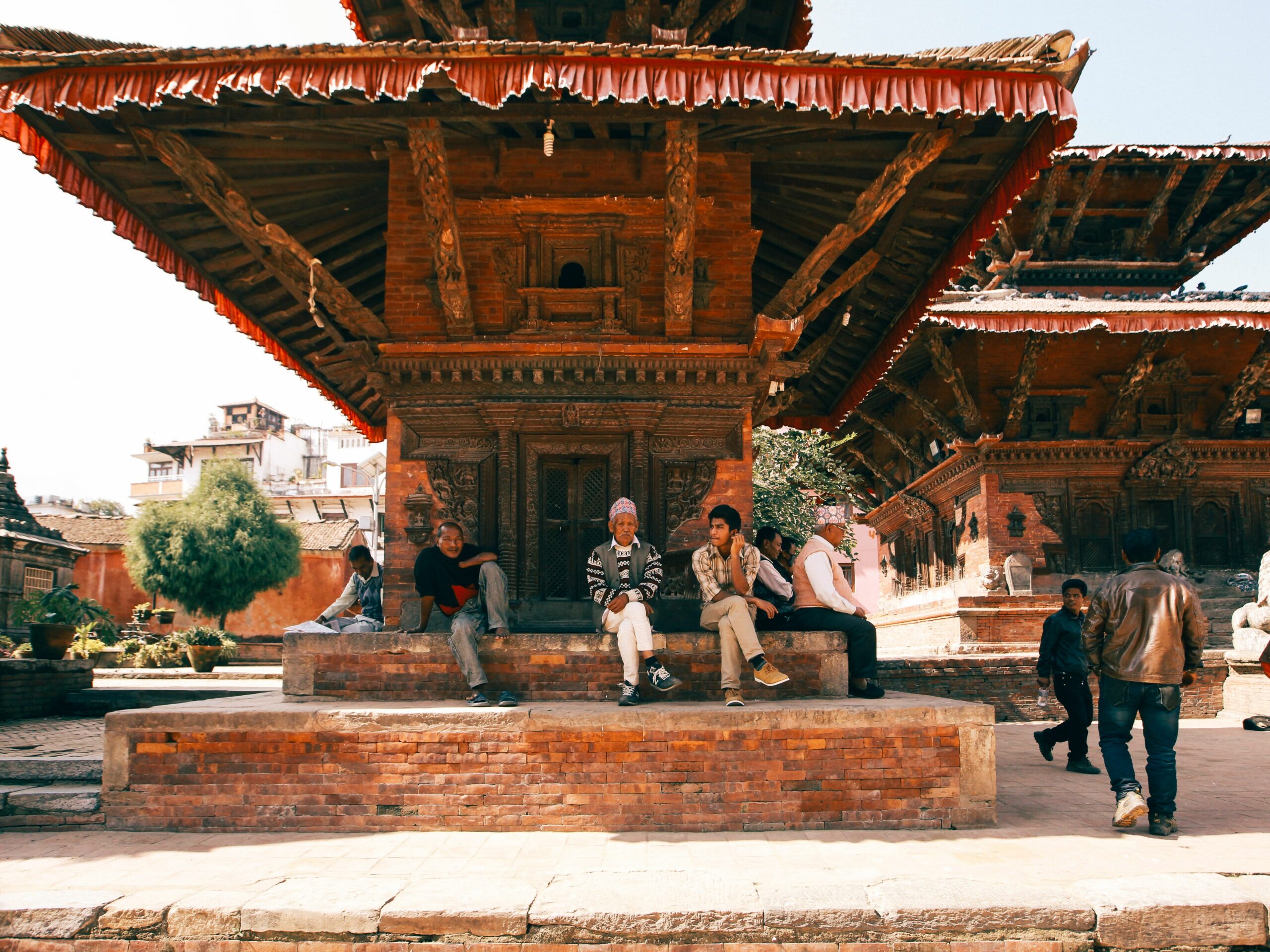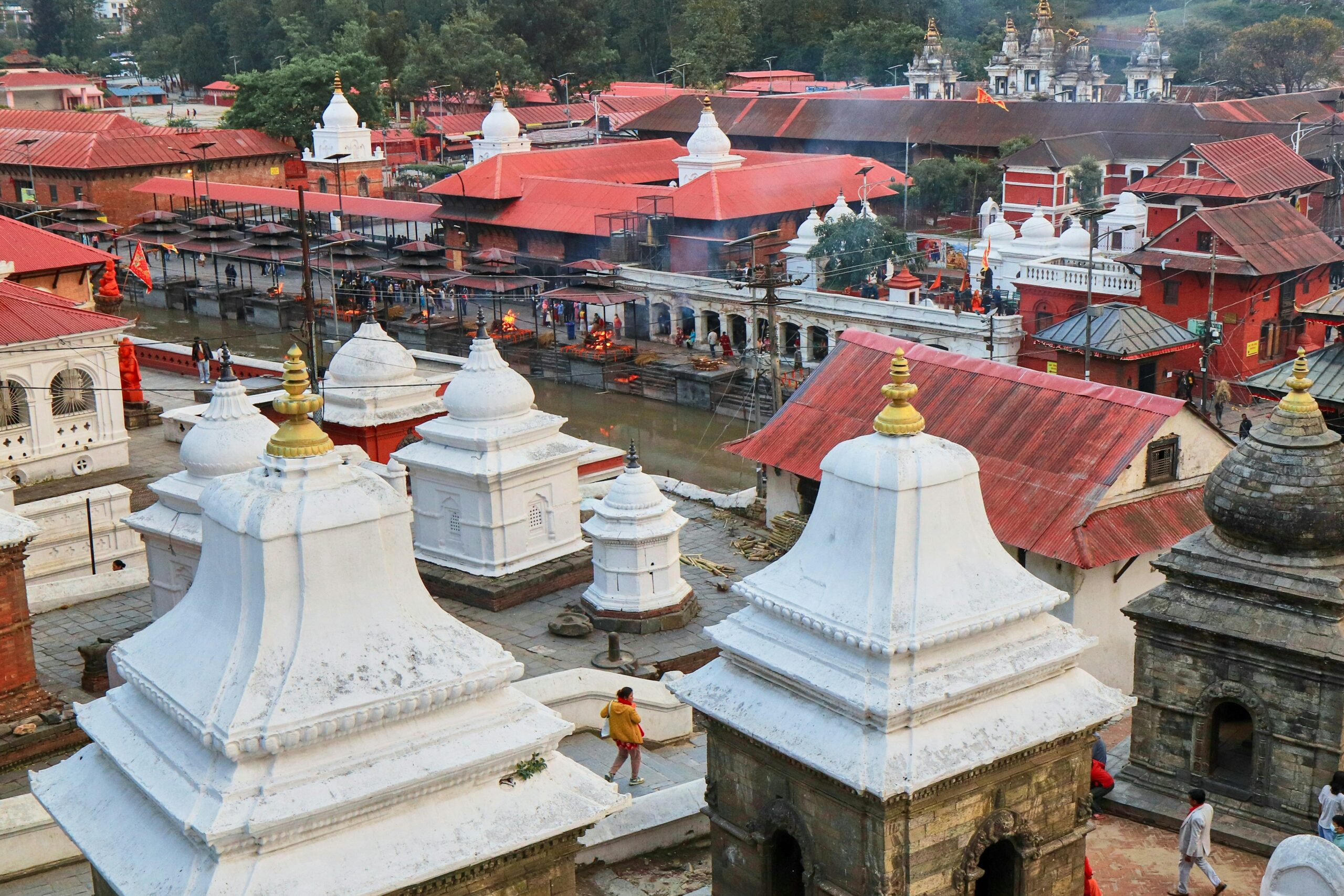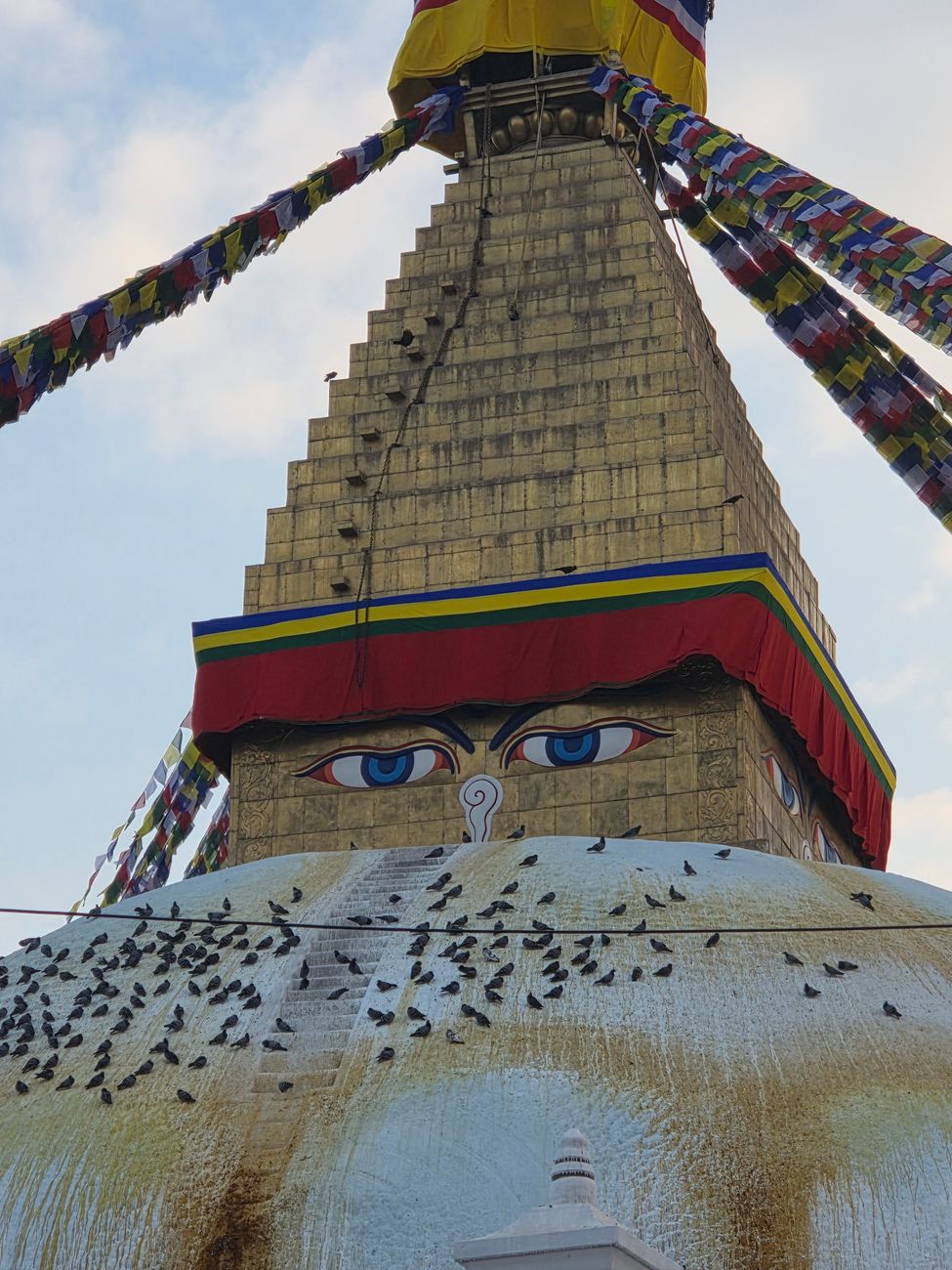
About twenty kilometers from Kathmandu, the crowded streets of the capital gradually give way to the hills of the valley. In Pharping, Buddhist monasteries, Hindu shrines, and pilgrimage sites coexist in a much more peaceful setting. For us, this stage also marks a turning point: after discovering Kathmandu’s major spiritual sites, we begin to experience the journey differently.
Leaving Kathmandu Behind
Since the beginning of the journey, Nepal’s spiritual life has largely revealed itself through movement. At Pashupatinath, it accompanied the funeral ceremonies along the banks of the Bagmati River. At Bodnath, it followed the steady footsteps of pilgrims circling the great stupa. At Swayambhunath, it appeared among temples, prayer flags, and shrines overlooking a capital that remained ever-present on the horizon.
The road to Pharping introduces a natural break in this first part of the journey. As we gradually leave the Kathmandu metropolitan area behind and head south into the valley, the landscape changes. Buildings become less densely packed, the hills reclaim their place, and the atmosphere seems to grow calmer with every kilometer away from the capital.
Yet Pharping is not simply a quiet retreat chosen to escape the city’s bustle. For a long time, this small area has held an important place in the religious life of the Kathmandu Valley. Tibetan Buddhist monasteries have been established near Hindu temples and caves associated with major figures in Buddhism. Monks, pilgrims, residents, and visitors cross paths around places that continue to be used for worship rather than merely preserved as historical sites.
This is precisely what makes arriving here so interesting. After several days spent observing and learning, Pharping gives us the sense of gently crossing an invisible boundary between discovering sacred places and getting closer to the people who keep them alive.
A Place Shaped by Multiple Traditions
As is often the case in the Kathmandu Valley, reducing Pharping to a single religious tradition would overlook much of its character. Buddhism holds a particularly important place here, but Hinduism is equally woven into the area’s spiritual history.
This closeness is especially apparent around Sesh Narayan Temple, dedicated to Vishnu and regarded as a Hindu pilgrimage site. Just a short walk away are places associated with Padmasambhava, the eighth-century Buddhist master whom tradition credits with playing a major role in introducing and developing Tantric Buddhism in Tibet. Within a relatively small area, religious references, practices, and stories come together without one necessarily displacing the other.
After Swayambhunath, this coexistence begins to feel more familiar. What may have seemed surprising during our first days in Nepal gradually reveals itself as one of the valley’s defining characteristics: sacred places do not always follow the religious boundaries a Western visitor might expect.
Following in the Footsteps of Padmasambhava
Several of the places that give Pharping its importance in the Buddhist world are associated with Padmasambhava, also known as Guru Rinpoche. A central figure in Tibetan Buddhism, he is believed to have meditated in this region during the eighth century before continuing his journey toward Tibet.
The stories surrounding his time here belong to a history in which biography, religious transmission, and spiritual tradition are closely intertwined. In Pharping, certain caves have become pilgrimage sites where people still come to meditate, leave offerings, or simply sit in quiet reflection.
Asura Cave is one of the best known. We will discover it the following day, when our stay in Pharping allows us to explore more deeply the history of Padmasambhava and the practices that continue to surround these places. For now, knowing that these hills have attracted practitioners, sometimes from great distances, for generations is enough to give the landscape another dimension.
Experiencing a Monastery Differently
Our arrival in Pharping then takes us to Nyedo Monastery, where we will spend the night. The change may seem modest within the overall itinerary, but it profoundly alters our relationship with the place. Rather than entering a monastery for a few hours before continuing on our way, we will, for the first time, stay.
Sleeping in the immediate vicinity of a monastic community allows us to glimpse a different reality from the one experienced during a brief visit. Buildings are no longer observed solely for their architecture, monks are no longer just figures glimpsed around a temple, and rituals are no longer scenes witnessed only from the outside. Little by little, the rhythm of the place becomes perceptible.

This immersion is deliberately gradual. We have not come with the ambition of understanding a complex tradition in a matter of hours or turning monastic life into an exotic experience. Being present, observing respectfully, and accepting that we may not immediately understand everything already offer another way of approaching travel.
The following morning, those who wish to may attend the 5 a.m. puja, before a conversation with a resident monk offers an opportunity to ask questions about Buddhism and everyday life at the monastery. Upon arrival, however, the essential thing lies elsewhere: settling in, leaving behind the pace of the preceding days, and realizing that we have entered a different stage of the journey.
When Rituals Cease to Be a Spectacle
This shift can also be felt in the way we approach religious practices. In Pharping, the itinerary includes attending a Mahakal Puja, a Buddhist ritual ceremony accompanied by prayers, recitations, and offerings.
For someone encountering these practices for the first time, a ceremony may initially be striking for what can be seen and heard. The gestures follow an order that is difficult to decipher, the recitations are sometimes impossible to understand, and certain symbols remain entirely unfamiliar to a first-time observer. Yet trying to interpret everything immediately could almost distract us from what is actually taking place.
There is an important difference between attending a ritual out of curiosity and being welcomed into a place where the practice holds meaning for those taking part. In the latter case, the visitor is not at the center of the scene. They temporarily enter a space that existed before their arrival and will continue to exist after their departure.
This position calls for a certain restraint, but it also offers something precious: the possibility of observing without turning every moment into an attraction.
At the Threshold of Monastic Life
At the end of the day, a walk through the village offers a glimpse of Pharping beyond its shrines. Everyday life continues around the religious sites. Residents use the same paths as pilgrims, and monasteries belong to the landscape rather than standing apart from it.

Perhaps it is this simplicity that most clearly distinguishes this stage from the preceding days. Kathmandu had accustomed us to a constant accumulation of sounds, movement, faces, and discoveries. Here, the interest lies less in the number of things to see than in the possibility of staying long enough to begin seeing differently.
Within the ORION journey, Pharping is therefore less another destination than a transition. We are still in the Kathmandu Valley, only a few dozen kilometers from the capital, but our relationship with travel is already beginning to evolve. The coming days will leave more room for meditation, conversations, walking, and practices experienced from within.
Before that, there is this first evening at the monastery. The bags are set down, our travels pause for a while, and the doors of Nyedo open onto an experience we will no longer have merely as visitors.