Some destinations take us out of our familiar surroundings. Then there is Nepal. From the very first moments, the feeling of being somewhere else goes far beyond a change of scenery or language. The way the streets come alive, the place of the sacred, the rituals woven into everyday life, the festivals that mark the year, and the way different traditions coexist create a world rarely encountered elsewhere in quite the same form.
When discovering the country for the first time, the contrast can be striking. Familiar points of reference become harder to find, while unfamiliar customs and ways of doing things emerge. Hinduism and Buddhism come together, temples and stupas are an integral part of the everyday landscape, celebrations spill into the streets, and gestures passed down through generations remain part of contemporary life.
What stands out, then, is not simply the difference, but the way everything seems to intertwine. The spiritual and the ordinary, the ancient and the present, beliefs and collective life do not appear confined to separate worlds. It is this distinctive character that gives Nepal such a particular identity and creates the feeling, upon arrival, that so many of our familiar points of reference have suddenly shifted.
The Street, a World of Its Own
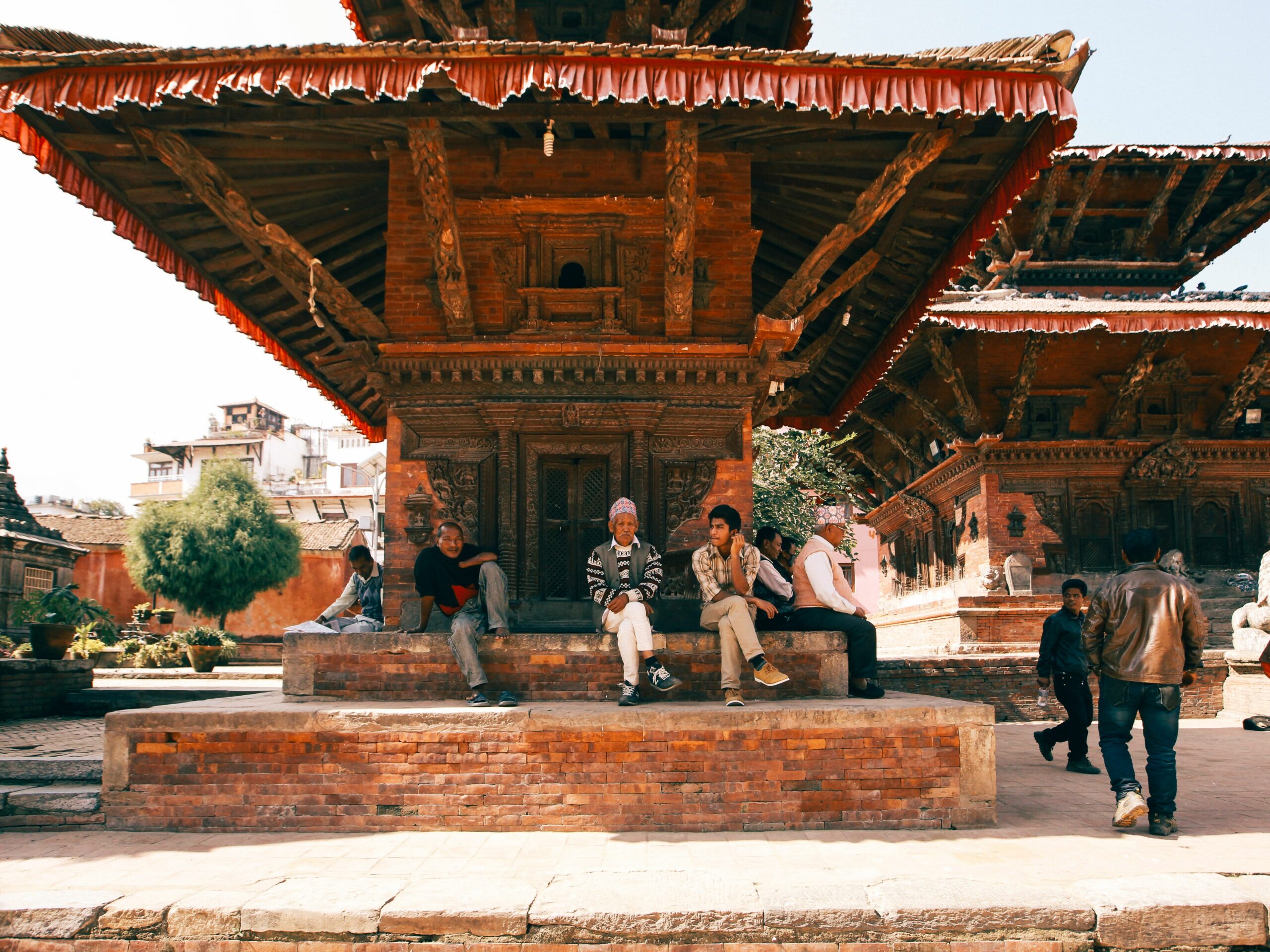
Kathmandu is a city experienced through all the senses at once. On certain streets, motorcycles, cars, pedestrians, and small vehicles cross paths in a constant flow that can seem impossible to make sense of when you first arrive. Horns punctuate the traffic, electrical wires crisscross above building facades, storefronts sometimes spill onto the sidewalks, and a few dogs sleep near a shrine, seemingly undisturbed by the activity around them.
The incense burning before a deity may mingle with the aroma of a kitchen where spices are simmering, before dust, exhaust fumes, or smoke from a small roadside stall takes over. Colors follow the same principle of accumulation: red powders placed on foreheads, bright saris, monks’ robes, offering flowers, brick facades, and prayer flags suspended overhead.

The sense of being somewhere unfamiliar also appears in details we may not think about before leaving home. In many major cities around the world, traveling often means recognizing familiar brands almost despite ourselves: store signs, shop windows, and commercial conventions that have become nearly identical from one country to another. In Nepal, large international chains remain much less prominent. Small shops, workshops, local restaurants, street vendors, and independent businesses still occupy much of the urban landscape.
This may seem insignificant until we realize how much these familiar signs usually contribute to our sense of normality. When they disappear at the same time as the traffic patterns, architecture, clothing, sounds, and smells change, the feeling of being somewhere else becomes much more profound.
The Sacred at the Heart of Everyday Life
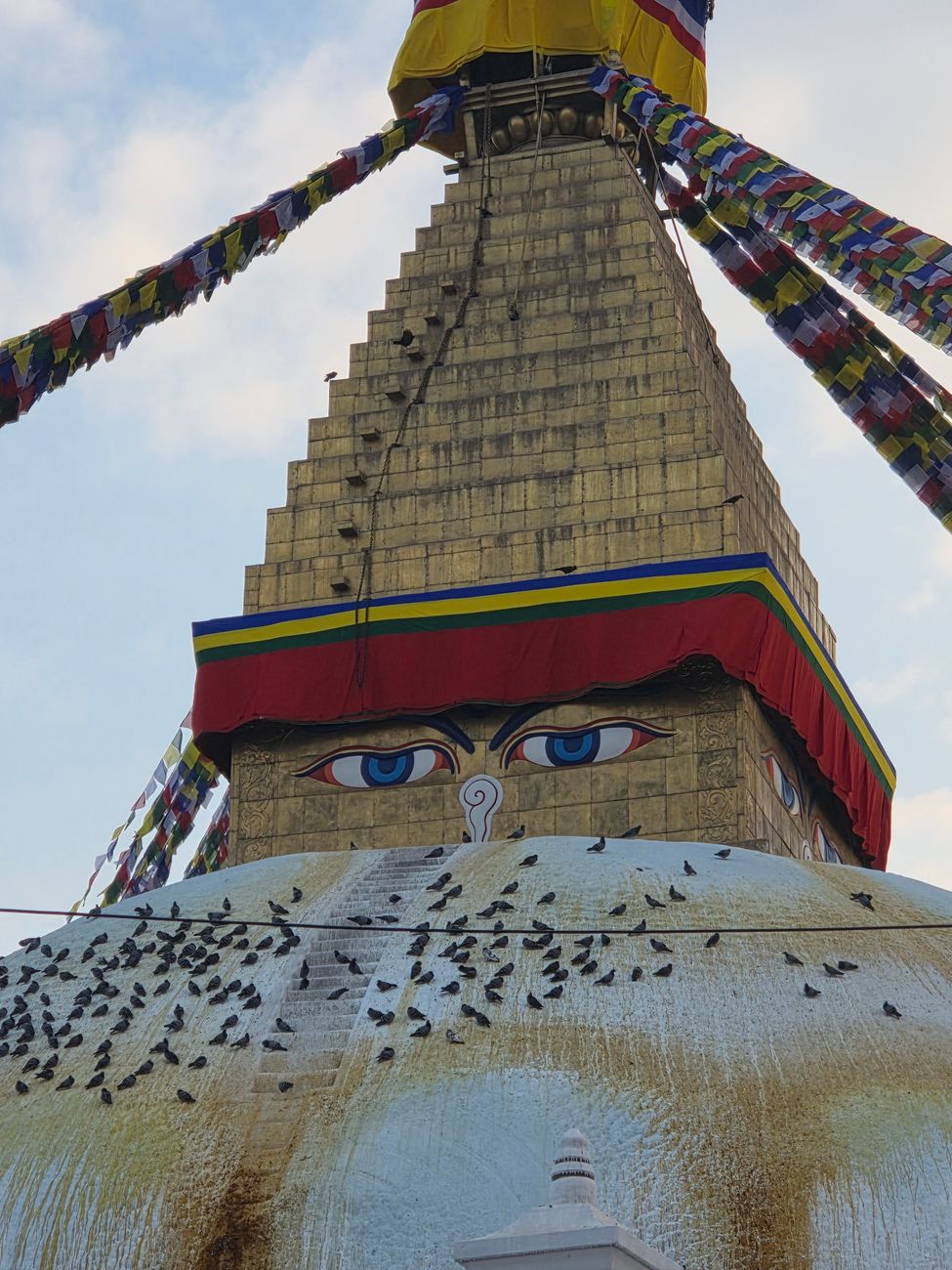
Perhaps one of the most striking differences is the place spirituality occupies. In many societies, places of worship are clearly defined, and religious practice remains relatively separate from the rest of urban life. Here, that boundary seems much more fluid. A small shrine may occupy a street corner, a deity may receive flowers and vermilion powder in the middle of a busy square, and prayer wheels may accompany people passing by. A stupa becomes, all at once, a place of devotion, a meeting place, and part of everyday life.
Religion no longer appears only when we decide to visit a temple. It emerges during a journey, a meal, a walk, or around a corner.
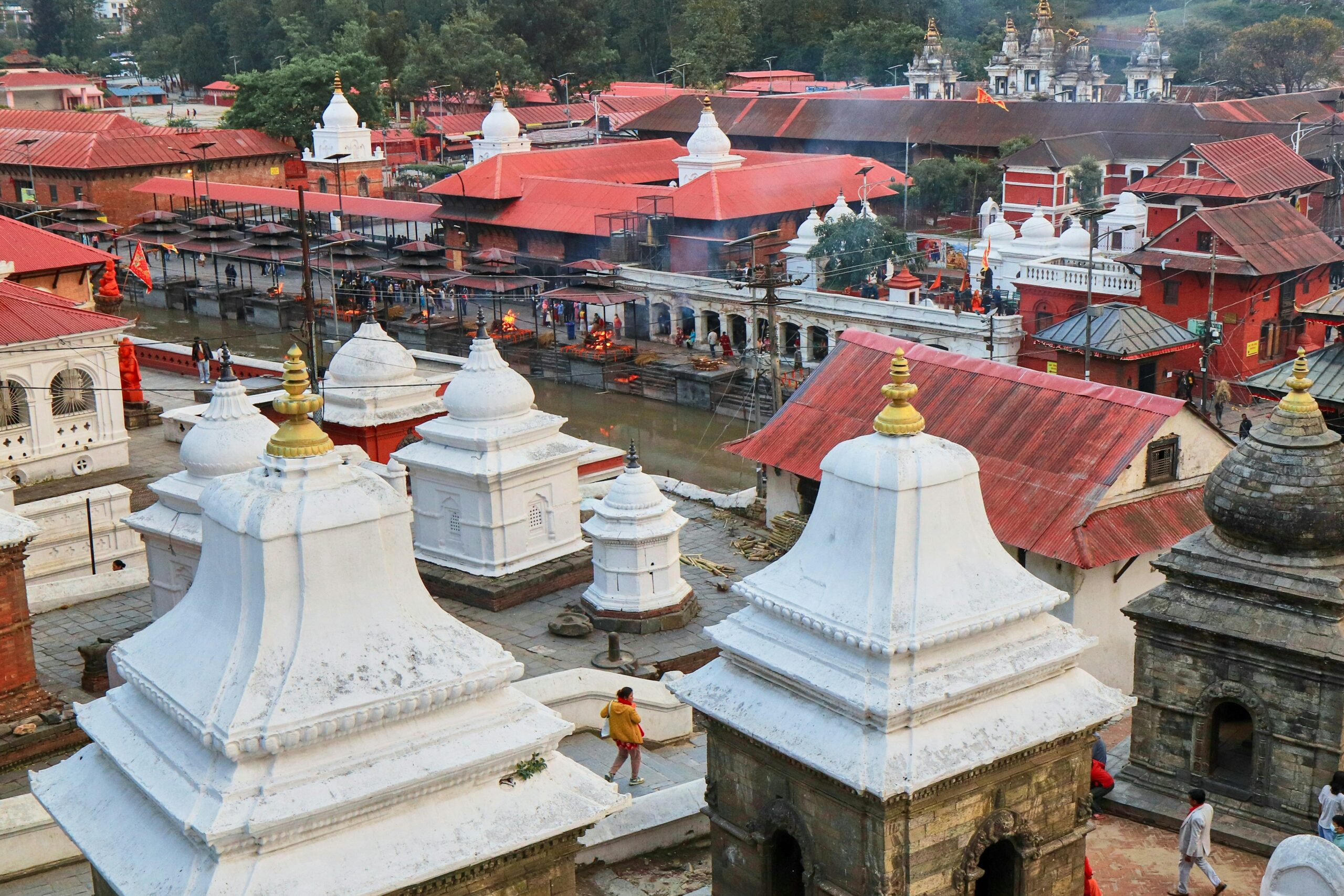
At Boudhanath, pilgrims circle the great stupa while shops and cafés carry on around them. At Swayambhunath, Buddhist symbols, Hindu shrines, and devotional practices share the same setting. At Pashupatinath, the connection between spirituality and human existence becomes even more visible as funeral ceremonies take place publicly along the banks of the Bagmati River.
For those accustomed to seeing spirituality occupy a more discreet place in daily life, this closeness can be surprising. Above all, it reveals a different understanding of the sacred: here, it accompanies life rather than waiting behind a doorway to be encountered.
Where Beliefs Meet
Trying to divide Nepal into a Hindu world on one side and a Buddhist world on the other would mean overlooking an essential part of what we observe.
In the Kathmandu Valley, the two traditions have existed alongside one another for centuries. Their encounters have profoundly influenced architecture, religious practices, and Newar culture. Certain places are more clearly associated with one tradition or the other, but elsewhere the boundaries become less obvious: symbols echo one another, practices overlap, and several traditions may belong to the same cultural setting.
This closeness has developed over centuries. Hinduism and Buddhism have evolved alongside tantric traditions and older practices, creating a spiritual landscape in which influences meet without always following the boundaries we might imagine between religions.
It is also something we sense as we travel through the country. Buddha, Shiva, stupas, temples, monasteries, sadhus, monks, offerings, and prayer wheels do not seem to belong to several separate worlds. They are part of the same human landscape, where different beliefs have come to coexist.
This coexistence does not, of course, mean that all practices are identical or that differences disappear. Rather, it reflects a long history of contact, influence, and mutual borrowing that makes Nepal particularly difficult to understand through the categories we are accustomed to using.
A Year Shaped by Celebrations
Traditions extend far beyond temples and are woven into the calendar itself. Upon arriving in Nepal, it can feel as though a festival, ceremony, or celebration is never far away. The idea of a public holiday every three days would be an exaggeration, but it captures a certain impression: the Nepali year is punctuated by a remarkable number of religious, cultural, and community gatherings.
Dashain brings families together for several days around one of the country’s most important Hindu celebrations. Tihar illuminates homes and streets and dedicates different days to deities, family bonds, and even certain animals. Holi transforms public spaces into an explosion of color, while Buddha Jayanti celebrates the birth of the Buddha. In the valley, Indra Jatra and Bisket Jatra are among other traditions that periodically give the streets an entirely different character.
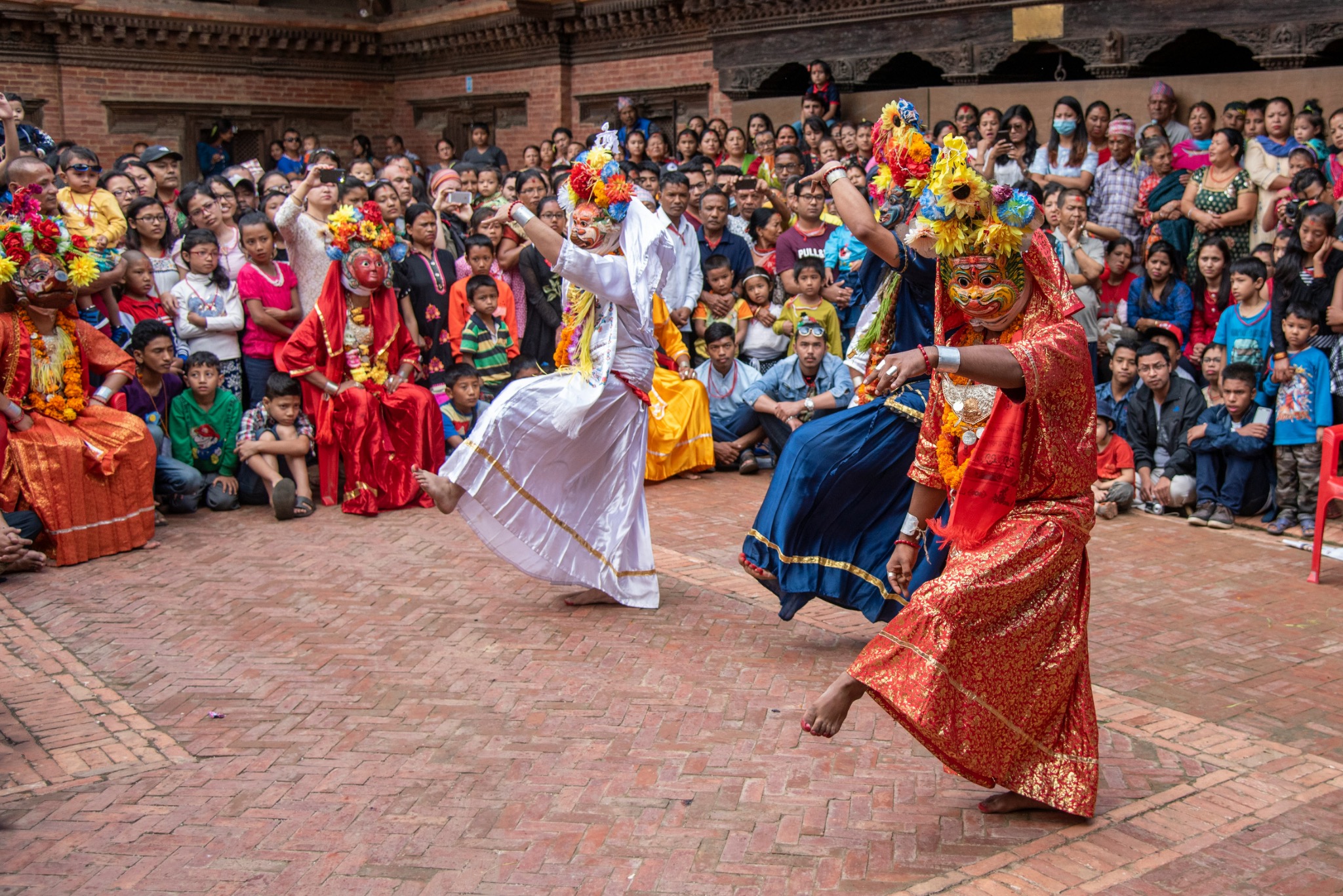
Alongside these are celebrations specific to certain communities or regions, days of puja, processions, family rituals, and numerous gatherings linked to the lunar calendar. Not all are national public holidays, but their frequency says something about the place these traditions continue to hold in society.
Time, then, is not measured solely in workweeks, weekends, and vacations. It is also organized around honored deities, seasons, religious cycles, family gatherings, and customs passed down from one generation to the next.
When Difference Becomes Part of Everyday Life
The true culture shock may reveal itself most clearly in ordinary things. It is not only before an immense stupa or during a ceremony that we become aware of how different things are from what we know. It appears when we watch someone leave an offering before beginning their day, when a small shrine fits naturally between homes, when traffic seems to follow rules we have yet to understand, or when several generations take part in a custom whose origins reach far beyond their own lifetimes.
Even the relationship with animals can draw our attention. Dogs, monkeys, cows, and pigeons share certain spaces with residents and sometimes take on a religious or symbolic significance that goes far beyond their simple presence in the street.
The relationship with death is undoubtedly one of the most powerful examples. At Pashupatinath, witnessing cremations on the ghats of the Bagmati River can be one of the most striking moments of a first visit to Nepal. They take place beside a sacred river, amid prayers, families, pilgrims, and the movement of the city, revealing a relationship with death that many visitors encounter for the first time.
As these observations accumulate, we begin to understand that the feeling of being somewhere else does not come from an exotic setting added to a way of life that otherwise functions like our own. It also stems from much deeper elements—the place of religion, ways of celebrating, and relationships with public space, community, and death—which find their own forms of expression here.
Learning to Observe Before Trying to Understand
At the beginning of a journey, comparisons come easily. We look for what resembles what we know and immediately notice what is missing, what surprises us, or what we do not yet understand. Over time, our perspective changes: the noise that once seemed chaotic begins to reveal its patterns, small shrines become recognizable, and certain gestures observed repeatedly gradually begin to make sense.
We become better at distinguishing what belongs to Hinduism, Buddhism, Newar culture, or shared practices, while also understanding that the boundaries between these worlds do not always follow the categories we instinctively use. Travel becomes particularly interesting when difference stops being a succession of surprises and becomes an invitation to understand.
Nepal does not need to resemble our familiar points of reference to become understandable. It simply asks for a little time, curiosity, and the ability to accept that certain things may work differently without immediately having to interpret them through our own system.
Throughout the ORION experience, this discovery accompanies the entire journey. It begins in the streets of Kathmandu, continues around the stupas, in temples and monasteries, and then takes on new forms through encounters and practices. Each stage adds another piece to something that cannot be fully grasped in a single day.
We arrive with habits, points of reference, and a certain idea of what seems normal to us. The country does not erase them; it simply brings them face to face with other ways of believing, celebrating, sharing space, and organizing life.
And when all our familiar points of reference shift, perhaps the most valuable thing is not to try to recover them immediately, but to discover everything that becomes visible when we accept, for a while, seeing the world from another perspective.