On the banks of the Bagmati River, prayers mingle with the smoke rising from funeral pyres. At Pashupatinath, death is not hidden behind walls. It has a place at the heart of a living sanctuary, among temples, pilgrims and families who have come to accompany their loved ones.
Along the River
At Pashupatinath, the first few minutes are enough to understand that this is no ordinary monument. Bells ring between the temples, pilgrims approach with their offerings, and below, the Bagmati River flows through the sanctuary. Considered sacred by Nepal’s Hindus, the river plays an essential role in the religious life of this place.
Along its banks, smoke rises from the funeral pyres where the deceased are cremated. What first strikes visitors is the proximity of it all. The ceremonies take place in the open air, while just a few yards away, others come to pray, leave an offering or simply walk through the grounds.
Our cultural guide accompanies us as we discover the site. Their presence gradually helps us make sense of what we are seeing, because behind the gestures visible from the opposite bank lie ancient traditions and an understanding of death that may be very different from our own.
Pashupatinath is therefore more than a place to admire. It is one of Nepal’s most important Hindu sanctuaries, an active place of worship where people come both to honor the gods and to accompany loved ones through the final moments of their lives.

A Sanctuary Dedicated to Shiva
To understand what takes place along the river, we must first learn about the deity to whom Pashupatinath is dedicated: Shiva, one of the principal deities of Hinduism.
Shiva is often described as the god of destruction. The word may sound unsettling when we first encounter it, but its meaning runs deeper. In Hinduism, destruction also makes transformation possible: something comes to an end so that something else can take its place. Endings and beginnings are thus part of the same movement.
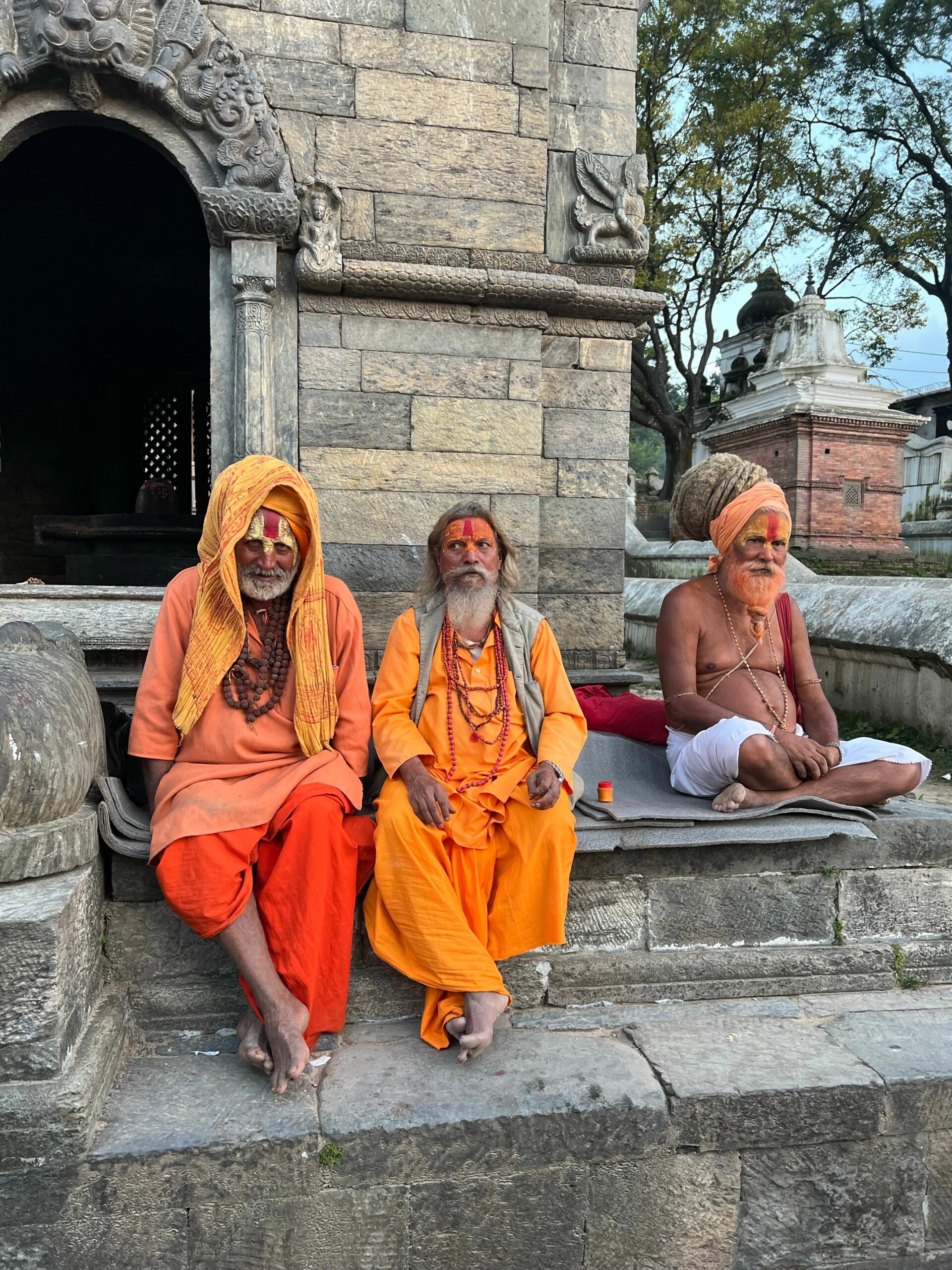
At Pashupatinath, Shiva is worshipped as Pashupati. The main temple dedicated to him stands on the western bank of the Bagmati. Its inner sanctuary is reserved for Hindus, but the site extends well beyond this building. Around it are smaller temples, prayer areas and long flights of steps descending toward the water.
These steps are known as ghats. Some provide access to the river for religious rituals, while others are used for funeral ceremonies and cremations.
As our guide explains their significance, the different elements of the landscape begin to connect: the temple dedicated to Shiva, the fire visible from the riverbank and the sacred river flowing through Pashupatinath.
Fire and the River
In Hindu tradition, cremation carries a meaning that goes beyond the disappearance of the body. Physical existence is considered temporary, and death is understood as one stage of a much larger spiritual path.
When someone dies, their loved ones accompany them to the cremation site. The body is prepared according to the family’s traditions, then placed on a wooden funeral pyre. Relatives perform the final rites before the fire is lit. Once the cremation is complete, the ashes may be entrusted to the Bagmati River.
The choice of this river is no coincidence. For Nepal’s Hindus, its waters are sacred. Farther downstream, the Bagmati joins the river system of the Ganges, which also holds a fundamental place in Hinduism. The water is therefore part of both the purification rituals and the deceased’s final passage.
Fire has its own significance. It transforms the body and marks the separation from earthly existence. What we witness from the riverbank is therefore more than a cremation: every element, from water and fire to the gestures of the family, belongs to a ceremony intended to accompany the deceased after death.

Understanding Death as a Passage
To explore this further, we need to look more closely at how Hinduism understands existence.
According to this tradition, death does not necessarily mark the end of the path. The soul may experience several successive lives, passing through birth, death and rebirth. This cycle is known as samsara.
One of the great spiritual goals is to eventually become free from this cycle. This liberation is called moksha: it represents the end of the cycle of rebirth and the liberation of the soul.
These ideas may seem abstract when we first encounter them. On the banks of the Bagmati, they become easier to grasp. The fire, the water and the rituals performed around the deceased take their place within a worldview in which death is understood not only as an ending, but also as a passage.
This does not, of course, mean that losing a loved one is experienced without pain. The families present are grieving, and the ceremonies we witness belong to deeply intimate moments in their lives.
The difference lies instead in the place given to death. Here, it is not concealed far from everyday life. Loved ones, religion and rituals passed down through generations accompany it.
Discovering Pashupatinath when we come from a culture where death is generally far less visible can stir many reactions. Curiosity, sometimes a certain discomfort, but also a desire to understand what is happening before us.
This is where our guide’s presence becomes especially meaningful. Their explanations allow us to look beyond the funeral pyres and discover the beliefs and traditions that give these ceremonies their meaning.
They also remind us that we are visitors here.
On the other side of the river, people are accompanying someone they love. Watching from a distance, respecting the ceremonies and avoiding intrusive photographs become simple but essential gestures.
Not everything becomes familiar to us, and it doesn’t need to. Traveling also means encountering traditions we do not share and seeking to understand them without needing to make them our own.
What Pashupatinath Leaves Behind
When the time comes to leave Pashupatinath, certain images remain with us: the temples lining the river, the offerings, the flames glimpsed from the opposite bank, the families gathered together and the prayers continuing as life carries on around them.
Just a few hours earlier, these scenes may have seemed difficult to understand. Now, they have a history, beliefs, and a purpose that give them meaning.
Pashupatinath does not teach us how to think about death. It simply introduces us to another way of giving death a place, without completely separating it from the life that continues around it.
We leave with our own convictions, but also with new questions. About our relationship with the end of life, the gestures that accompany those who are leaving us, and what different cultures choose to reveal or, on the contrary, keep at a distance.
The Bagmati continues its course between the two banks. Pilgrims keep arriving, bells continue to ring, and families carry on performing rituals passed down through generations.
And perhaps this is the truest image Pashupatinath leaves behind: a place where life and death are not opposites, but continue to exist side by side.